Elastic- stretchable, malleable but also prone to slacking over time. That’s how I would describe Alice’s story- something that she herself doesn’t understand before it is too late. The book starts with the protagonist, Alice examining her vagina and feeling alienated from her own body and disconsolate about her sexuality.
She is content with her partner Simon, they love each other and live together and things are fine. Enter Mathilde, and Alice’s life changes. Mathilde is Alice’s colleague and Alice is drawn to Mathilde like a moth drawn to a flame. Enter Alexander – Mathilde’s husband – and things take an even more complicated turn. Alexander and Mathilde are in an open marriage and to get closer to Mathilde, Alice starts to sleep with Alexander. Alexander is merely the means to get to the end, to Mathilde.
Eventually, Alice also discovers secrets from Simon, and after that, it’s a roller coaster ride that takes us through this quadrilateral relationship- of love, of intimacy, of desire, of jealousy, of hate, of queerness, of identity and of feminine struggles.
Johanne Bille did a marvelous job with this book- amalgamating the many sides to human identity and relationships into one story narrated by Alice’s complex character. Despite the many themes and the many moods of Alice that the book touches upon, the writing is perspicuous through and through.
I thought, I thought and I thought and could not think of any adjectives to describe the book. The imagery is wonderful, the translation is lyrical, the writing is brilliant, the story is emotional and I just choked up in the end. Please read it, NOW.
the rest of the time I’m this haze drifting about“
New Passengers was my fourth WITmonth read and it is the first verse novel I’ve ever read and one that I loved. I finished this in one sitting today. The book is divided into months (August-December) and follows the unnamed narrator’s discovery of herself, her young feminine identity and what it means to be an adult. The novel starts with the narrator boarding the daily commute train from Copenhagen to Naestved where she’s landed a new job as a teacher in a school. On the train, she meets a married man to whom she is drawn irrevocably; and what follows are events through which the narrator confronts her own identity coupled with her relationship with this man. In between all of this exists her id- which does not let her extricate herself from this man and, her ego- which reminds her of the uneasiness and the immorality of infidelity.
The book flows with such lucidness and that too with sparse words- fiction that reads and looks like poetry. The translation was beautiful and captured all the nuances. Evocative, perspicuous and fact-paced like that of a train but also reflective, New Passengers is an amalgamation of love, reflections on adulthood and feminine identity in the contemporary world. I think the design of the book speaks so much for itself with the rectangle(s) on the chapter page that somewhat resembled commuter train carriages. With each progressing month, there is an extra rectangle/ carriage and by December (the last month), it was a complete commuter train. For me, this resembled closure and the start of a new adulthood.
I loved the coming-of-age story. I’m not sure but I think if I had to fit this into a genre, it would definitely be bildungsroman. This was definitely one of my favourite books in fiction this year and from what I can tell, will continue to be a favourite for days to come!
New Passengers was first published in Danish in 2017 titled ‘Nye rejsende’ and later translated into English by Misha Hoekstra which will be out on 10th September 2020! The book won the Englush PEN award and also ‘Bogforum’s Debutantpris’, the prize awarded each year for Denmark’s best literary debut.
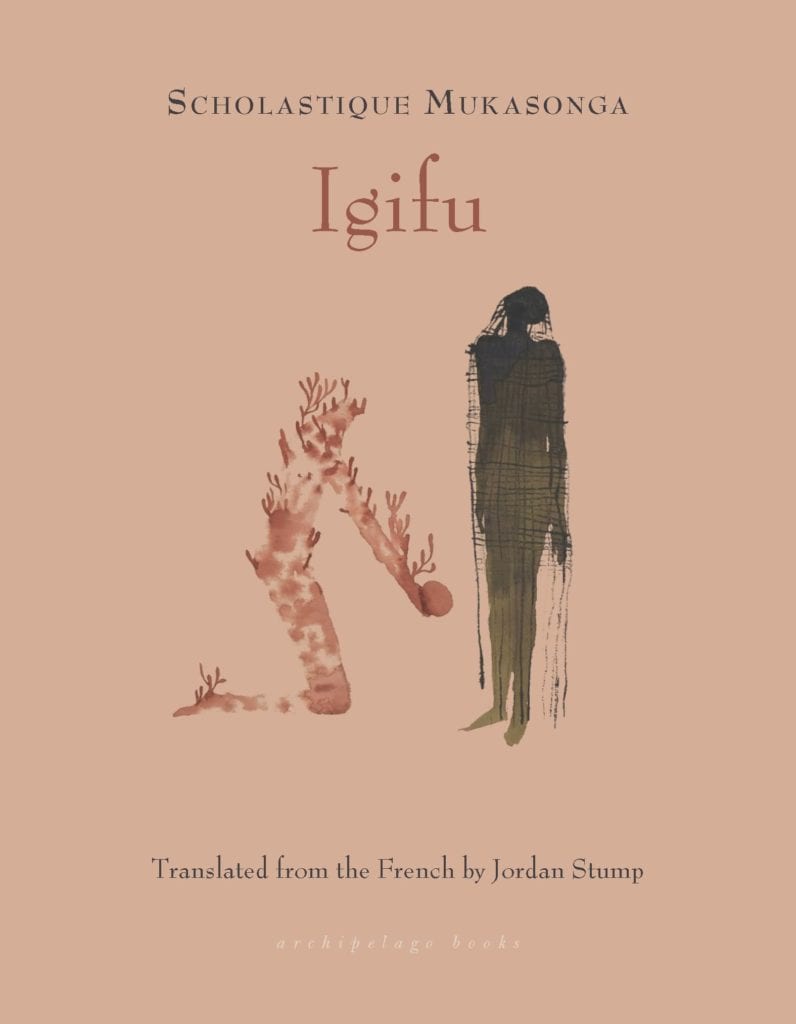
Igifu, Scholastique Mukasonga tr. by Jordan Stump Published by Archipelago Books Genre- Autobiographical fiction, Short Stories Rating: 5/5
“In Nyamata,’ my mother used to say, ‘you must never forget: we’re Inyenzi, we’re cockroaches, snakes, vermin. Whenever you meet a soldier or a militiaman or a stranger, remember: he’s planning to kill you, and he knows he will, one day or another, him or someone else”.
Igifu, or hunger, is a collection of autobiographical stories by the French-Rwandan author Scholastique Mukasonga and is translated from the French to English by Jordan Stump. In the centre of these stories is the collective grief and predicament of Tutsis -the living, the dead and the exiled – before and after the Rawandan genocide. Each story is heartwrenchingly beautiful, visceral and permeates through all yours senses.
The first story in the book is called ‘Igifu’, where the author takes us through a literary experience of hunger- of what it means to have this implacable tormentor within and what it does to the human body and mind. They knew how to satiate Igifu when they had their cows but the cows were taken away and killed, and the Tutsis were abandoned on the sterile soil of the Bugesera, Igifu’s kingdom. (“Igifu woke you long before the chattering birds announced the first light of dawn, he stretched out the blazing afternoon hours, he stayed at your side on the mat to bedevil your sleep. He was the heartless magician who conjured up lying mirages: the sight of a heap of steaming beans or a beautiful white ball of manioc paste, the glorious smell of the sauce on a huge dish of bananas, the sound of roast corn crackling over a charcoal fire, and then just when you were about to reach out for that mouthwatering food it would all dissolve like the mist on the swamp, and then you heard Igifu cackling deep in your stomach.”)
The second story is called “The Glorious Cow” where the author reminisces the halcyon days of when they had a lot of cows. The cows were given names, looked after and were the most important members in the family. Here, we learn the cultural and agricultural importance of the cow in Tutsi families. Milk after all, helped keep Igifu away. The third story, which almost had me in tears is called “Fear”- the fear of the sound of boots, of soldiers planning to kill, where you have to be quicker than death. Fear is their guardian angel, it helps them stay alert and awake for when death knocks, you have to run faster than death. The fourth story is called “The Curse of Beauty”- of how beauty was the greatest sorrow in the life of a Tutsi woman that extricated her from her husband, her son and herself. The last story in the book is “Grief”- here, the author writes about what it is like to lose people to a genocide and what it takes to come to terms with it (“That strength lives in you too, don’t let anyone try to tell you to get over your loss, not if that means saying goodbye to your dead. You can’t: they’ll never leave you, they stay by your side to give you the courage to live, to triumph over obstacles, whether here in Rwanda or abroad, if you go back. They’re always beside you, and you can always depend on them.”)
Igifu was my first read for Women in Translation month. WITMonth started in response to literary blogger Meytal Radzinski’s observation that only around 30% of books published in translation were by women. The purpose is to support women writers in translations and to bridge the gap through reading, reviewing and discussing books by women writers in translations.
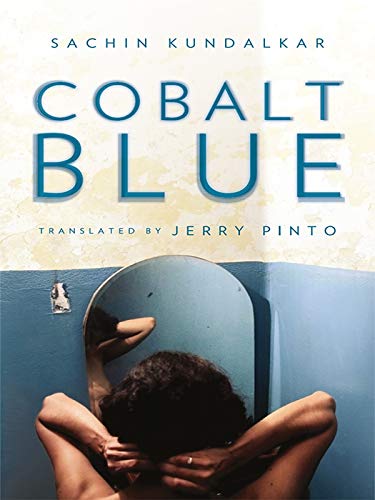
There are books that you read through which you’re able to uncover undertows of your own existence- this is one of them. My penchant for heart-wrenching stories emanates from a sense of my own being. All of us are inextricably linked with one another and we like things that remind us of ourselves and our lives, the sense of familiarity is comforting and what’s unknown is exciting. Looking for bits and pieces of us in things and people is inexorable, which is why we love things that are “relatable”. Cobalt Blue was one such book, it was more like an experience that brought lumps in my throat at times and I loved every bit of it.
What a heart-wrenching tale of love, or rather two distinct lovers- Tanay and Anuja who happen to be siblings and who fall in love with the same person- an anonymous tenant. It is narrated by the siblings in two parts- first Tanay and then Anuja. Cobalt Blue is a story of commonality of love, loss, and longing that is shared between Tanay and Anuja, that takes them on nothing short of a roller-coaster ride; yet they do not communicate this with each other. The book was replete with familiar surroundings and feelings for me- Pune and love found and lost. The author has beautifully brought to life two relationships together, one homosexual and the other heterosexual. Truly a masterpiece and one of the finest pieces of translated fiction I’ve ever read. I’m looking forward to reading this in Marathi, the language in which it was originally written but rest assured, Jerry Pinto has kept the translation faultless.
Following is a quote borrowed from Jerry Pinto’s Translator’s note ~
“You realize that this is how we grieve, how we remember, in the present tense and in the past, all at once, because the imagined future must now be abandoned”
Perhaps this is how stories end, quickly, and with a future suddenly left uncertain with the absence of the person you didn’t imagine you’d have to live without. At the intersection of the beautiful prose by Pinto and Kundalkar’s intentions, lies a magnum-opus of LGBT literature; not only does it touch upon a gay relationship but also a bisexual one. Also, on another note, pride month ends but pride continues.
Post Script– Wrote this review last month immediately after finishing the book, hence the pride month reference. I did not read this because I should be reading LGBT literature during Pride month by the way, LGBT literature should be consumed as naturally as any other. Consume them like you consume your greens or legumes. I’ve had a reading hangover since I’ve read Cobalt Blue, this book is intoxicating and one that I’m definitely going to re-read.


 Literature, Poetry and Reading.