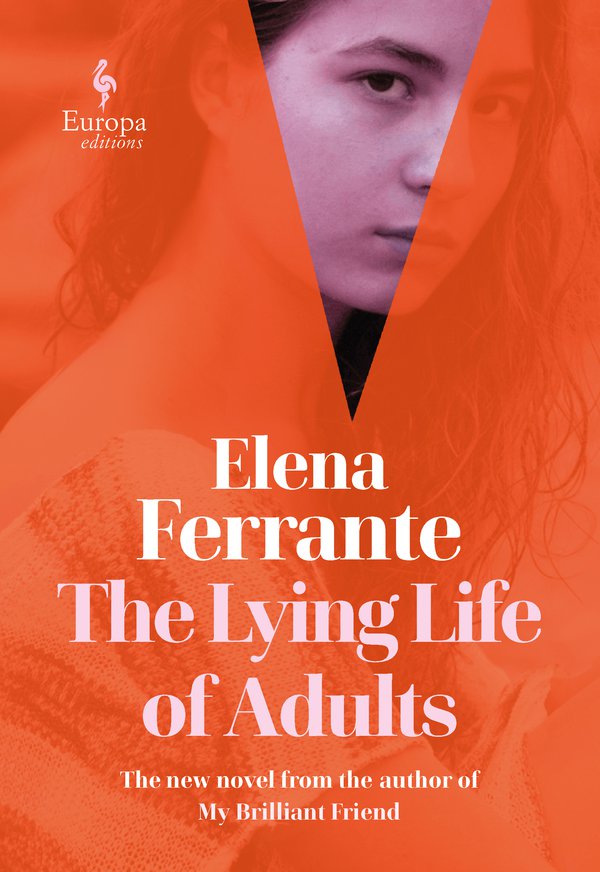
The Lying Life of Adults by Elena Ferrante tr. by Ann Goldstein

The Lying Life of Adults - Elena Ferrante
Publisher: Europa Editions
Genre: Coming-of-age, literary fiction, bildungsroman
Rating: 4.5/5

“Two years before leaving home my father said to my mother that I was very ugly.” When a book opens with a line like that, you know it’s going to be an immersive read with some brilliant characterization and a sublime plot. The way Ferrante selects the most quotidian things and paints them with her vivid imagination and lyrical writing, bringing them to life in her reader’s mind is nothing short of exquisite.

With ‘The Lying Life of Adults’, Ferrante has made her way into my most favourite writers of all time list. I read Days of Abandonment by her earlier this year and thoroughly enjoyed it. The Lying Life of Adults is another coming-of-age literary masterpiece by Ferrante. The book pulls you into the story of Giovanna from the very beginning. The story follows the story of Giovanna spanning her 13-16th year as she grapples with her own self as well as the lives of adults around her. She belongs to an affluent family with academic parents, who live in an affluent neighbourhood and have like-minded friends. She transforms from being a compliant and sometimes, a trophy child to finding her own voice and asserting herself in front of her family, friends and other like-minded people from the so-called intelligentsia of Naples.

She is inexplicably drawn towards her father’s side of the family, especially her aunt Vittoria- the most hated person in her family- someone who is considered ugly inside out by Giovanna’s parents. After her father calls Giovanna ugly and compares her to his sister Vittoria, Giovanna sets off on a journey to the depths of Naples (a place of squalor and vulgarity) and also to the depths of her self, family secrets and other relationships. Her journey from the heights of Naples to the depths of Naples marks not only a physical journey from the North to the South but also her transition from childhood to adolescent.

What I loved about this book is the recurring theme of the superficial and hypocritical lives that adults live- they expect their children to be a certain way when they grow up- to be honest, just, etc., but they themselves lead a two-faced life of lies and double standards. The lives of adults are divided by class and wealth but united by their knack for lying. The book also touches on many other themes such as the constructs of beauty, the male gaze, faith, love and lust among others. The mention of umpteen number of Italian delicacies and places in the books transports you to her character’s Neapolitan world and culture. All the characters in Giovanna’s story are brilliant and unique in their own ways- you will love some and hate some but you will not forget them.

I loved how the story took shape, how the characters and their relationships with one another evolved throughout the novel and it gripped me from the very beginning, I was unable to put it down at any point. The ending was a tad bit disappointing- I wish it were different but I loved the book nonetheless. Perfect for fans of Murakami’s Norwegian Wood and Sputnik Sweetheart or anyone who fancies coming-of-age novels with visceral and interesting characters.

Thank you to the publishers, Europa Editions UK for sending me a copy, I was beyond elated to have found this in my mail and I devoured it immediately.

“The circle of an empty day is brutal…”: Days of Abandonment by Elena Ferrante tr. by Ann Goldstein

Buy The Days of Abandonment Book Online at Low Prices in India ...

I read Ties by Domenico Starnone and loved it, I was particularly interested in Days of Abandonment because both books explore the fallout of a husband’s fidelity. The book was an emotional ride for me, it was depressing and I loved it. Starnone and Ferrante are married to each other and both their books touch upon the theme of a husband who leaves his wife and two children for a younger woman. Both also involve an old neighbor and a pet. Ferrante explores the mental agony of the wife after her husband abandons her and the turbulent aftermath of the marital betrayal; whereas, Starnone writes about the mental agony of the wife, the husband and lastly the children in three parts.

The novel is set in Turin where Olga lives with her husband Mario, her children Illaria and Gianni and their dog Otto. One day, Mario declares that he does not want to be with her anymore. The novel captures the wife’s descent into madness and finally finding some semblance after her husband deserts her for a much younger woman. Their neighbour Carrano also plays a significant role in the novel. Reading the book was almost similar to experiencing a real life vertigo- Olga’s suffering throughout the novel was portrayed brilliantly. It was raw, vulnerable, and a true description of the id. There is no sugar coating. Olga has given her husband everything- she carried him through his education years to raising his children and their home (quoting Olga, “I had taken away my own time and added it to his, to make him more powerful. I had put aside my own aspirations to go along with his. At every crisis of despair I had set aside my own crises to comfort him. I had disappeared into his minutes, into his hours, so that he could concentrate“).

She mentions at one point “We don’t know anything about people, even those with whom we share everything“. The veils of marriage, striving to be perfect for one another, the facades of personalities and pretence of being someone else for the sake of one another are shattered one by one throughout the novel; if only Olga had displayed this vulnerable side within the marriage. Not giving spoilers but the novel does not end badly, Olga learns to move on, to accept that life outside Mario is possible (quoting Olga,”What a mistake, above all, it had been to believe that I couldn’t live without him, when for a long time I had not been at all certain that I was alive with him“). She realizes that she did not feel like herself with him, she felt like another version of him, always adjusting and evolving according to his needs and desires.

Concluding Thoughts

I’ve already mentioned how reading the novel was similar to experiencing a vertigo for me. All in all, Ferrante paints a terrific picture of a wife’s mental descent during the days of her abandonment. It was beautiful, raw and visceral. Moreover, it is a reminder of how fragile human relationships are, how indecipherable people can be and how overcoming is difficult yet possible.

Domonico Starnone, Ties (Translated by Jhumpa Lahiri from the Italian ‘Lacci’)

Think of the book, Starnone’s writing and Lahiri’s translation as a puff pastry- there are so many layers to it, when you eat it you don’t realize, but the moment someone takes you through the process of making that perfect puff pastry you realize the intricacies of making the pastry, the umpteen number of layers and the richness between those layers. The book is exactly like that.

Domenico Starnone's New Novel Is Also a Piece in the Elena ...

****.5/5

I just finished reading Ties earlier toady, thus completing 20 books this year. More than the number of books, the quality and diversity of books that I read matter more to me. So I’ve been reading a number of books at once- Once and Forever: The Tales of Kenji Miyazawa by Kenji Miyazawa, Interpreter of Maladies by Jhumpa Lahiri, Invisible Women: Exposing Data Bias in a World Designed for Men by Caroline Criado-Perez and Modern Love. As much as I want to finish An Unquiet Mind: A Memoir of Moods and Madness by Kay Redfield Jaminson, my mind is inching closer to DNF’ing it.

If you’re reading Ties, please start by reading the Introduction by Lahiri, it provides some context to the family of Vanda, Aldo, Sandro and Anna and their tumultuous relationships with one another and as a family. Read it also because it is an interesting anecdote about Lahiri’s tryst with the book.

“Ties” is a story of a marriage and but also extends to other relationships, such as one with children, and lovers outside marriage. The book speaks about empty spaces, dead ends and about the communication that is dead between spouses. There is a lot more to it which seethes under the surface as beautifully imagined by Starnone. Think of the book, Starnone’s writing and Lahiri’s translation as a puff pastry- there are so many layers to it, when you eat it you don’t realize, but the moment someone takes you through the process of making that perfect puff pastry you realize the intricacies of making the pastry, the umpteen number of layers. The book is exactly like that, in the beginning it does not strike you as anything extraordinary. As you start progressing and as the author takes you through the different viewpoints of the characters, you understand the underlying emotions, the fault lines and everything in between. Starnone delves deep into the hearts and minds of the characters and makes the ordinary, extraordinary. It is a multi-faceted story about a broken marriage with children as its innocent victims. It is about what works, what doesn’t, who pretends and who doesn’t.

Concluding Thoughts

I loved Ties, it is one of those novels that just covered me with a sense of equanimity and warmth. I do not understand Italian but Lahiri’s translation of the book did not feel inadequate anywhere throughout the novel which is often the case with translated works. What disappointed me about the book was the characters’ reluctance to communicate effectively with one another, it was always expressed through frustration and repression, but maybe that’s the beauty of it. Domenico Starnone is married to Elena Ferrante who is the author of The Days of Abandonment, another story about a broken marriage, so I am really looking forward to reading that one next.

Design a site like this with WordPress.com
Get started