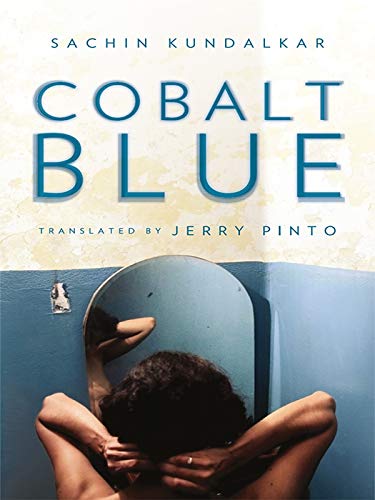
“When I think about my childhood, I feel the best times came before one began to seek pleasure in the bodies of others…”: Sachin Kundalkar’s ‘Cobalt Blue’ (Translated by Jerry Pinto)

Buy Cobalt Blue Book Online at Low Prices in India | Cobalt Blue ...

There are books that you read through which you’re able to uncover undertows of your own existence- this is one of them. My penchant for heart-wrenching stories emanates from a sense of my own being. All of us are inextricably linked with one another and we like things that remind us of ourselves and our lives, the sense of familiarity is comforting and what’s unknown is exciting. Looking for bits and pieces of us in things and people is inexorable, which is why we love things that are “relatable”. Cobalt Blue was one such book, it was more like an experience that brought lumps in my throat at times and I loved every bit of it.

What a heart-wrenching tale of love, or rather two distinct lovers- Tanay and Anuja who happen to be siblings and who fall in love with the same person- an anonymous tenant. It is narrated by the siblings in two parts- first Tanay and then Anuja. Cobalt Blue is a story of commonality of love, loss, and longing that is shared between Tanay and Anuja, that takes them on nothing short of a roller-coaster ride; yet they do not communicate this with each other. The book was replete with familiar surroundings and feelings for me- Pune and love found and lost. The author has beautifully brought to life two relationships together, one homosexual and the other heterosexual. Truly a masterpiece and one of the finest pieces of translated fiction I’ve ever read. I’m looking forward to reading this in Marathi, the language in which it was originally written but rest assured, Jerry Pinto has kept the translation faultless.

Following is a quote borrowed from Jerry Pinto’s Translator’s note ~

“You realize that this is how we grieve, how we remember, in the present tense and in the past, all at once, because the imagined future must now be abandoned”

Perhaps this is how stories end, quickly, and with a future suddenly left uncertain with the absence of the person you didn’t imagine you’d have to live without. At the intersection of the beautiful prose by Pinto and Kundalkar’s intentions, lies a magnum-opus of LGBT literature; not only does it touch upon a gay relationship but also a bisexual one. Also, on another note, pride month ends but pride continues.

Post Script– Wrote this review last month immediately after finishing the book, hence the pride month reference. I did not read this because I should be reading LGBT literature during Pride month by the way, LGBT literature should be consumed as naturally as any other. Consume them like you consume your greens or legumes. I’ve had a reading hangover since I’ve read Cobalt Blue, this book is intoxicating and one that I’m definitely going to re-read.
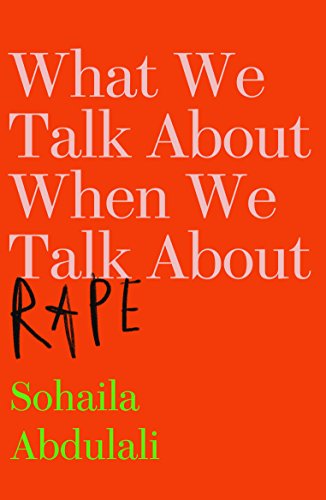
Sohaila Abdulali, What We Talk About When We Talk About Rape

What We Talk About When We Talk About Rape eBook: Abdulali ...

After reading what is now in my ‘100 books to read in a lifetime’ list, I realized how inadequate and superficial the conversation about rape and sexual assault is. Anyway, cutting to the chase, I loved this book.

Sohaila Abdulali is a writer, counselor, activist and survivor who delves into multifarious questions surrounding sexual assault and rape globally. For this book, she draws on her own experience, experiences of others, heavy research and her work as a head of a rape crisis center in Boston.

The book was brilliant for me because it’s a step forward in decrying the awkward silence that comes with conversations around rape and assault. It felt like a conversation full of insights, personal experiences and experiences of others. There are people from all over the world narrating their experiences with rape and abuse cutting across class, across profession and across regions.

The book made me pause and re-evaluate my preconceived notions about rape, objectification, humanity, and consent. The book opened my eyes, for instance, I did not know people could experience something like dentophobia after a horrifying experience. Or the story of Thordis & Tom. For those who don’t know, Thordis Elva was raped by her boyfriend Tom Stranger, an exchange student from Australia and after several years of torment she wrote to Tom to tell him of the pain he had inflicted on her. This marked the start of an eight-year correspondence culminating in the two of them meeting in Cape Town in 2013 and they later went on to start “The forgiveness project“that shares stories from both victims/survivors and perpetrators of crime and conflict who have rebuilt their lives following hurt and trauma. I found this story particularly fascinating.

I also had my light-bulb moment after learning that rape does not just happen because of objectification of women, there are multiple factors at play. The fact that one seeks vengeance, or seeks power over someone or seeks to humiliate is not because they view their victims as objects. We don’t feel the urge to humiliate objects. She also talks about mercy, about the taboos, incest, the prevention (if there really is one), difference between sex workers and trafficked humans, sexual autonomy, patriarchy and most importantly about rape.

Dishes

I grew up with a high regard for our housemaids, to the point that I would emulate their job and demand a fee later. For instance, in my aunt’s house in Kolkata, I would do a few chores like washing the dishes, dusting the shelves and my aunt would hand me a hundred rupee note after. I grew up to love doing dishes to the point that I would offer to help our mashi (housemaid, in Bengali). I was amazed by how she would go to at least ten houses per day and do not only dishes, but also jhadu (dusting) and pocha (mopping).

When I was in ninth grade, my friend in Pune had a knack for cleaning and she made sure that we kept the kitchen counter clean and organized while we experimented in the kitchen. Then came the post eating rituals. It was something as simple as keeping our dishes in the sink, throwing leftovers in the dustbin and pouring a little bit of tap water into our empty coffee mugs so that its easier for the bai (housemaid, in Marathi) to do the dishes.

Today when I look back, there is a sense of haughtiness that comes from being able to do chores without a sweat of frustration and I scorn at those who scorn at doing household chores. I am grateful that I grew up in an environment where I was encouraged to help our mashi do the dishes or at times forced to do my own dishes when mashi did not turn up, I am grateful to friends and their families who did not treat me like a privileged guest, but as a part of their own family and I was expected to keep the dishes in the sink like every other member. It’s made my life easier in the times of lockdown and otherwise where I now clean my own room, do my dishes and clean up the kitchen counter each time I cook something for my family. Some of my friends are struggling now and I, I laugh in the face of their adversity!

Basharat Peer, Curfewed Night


*****

“Srinagar is a medieval city dying in a modern war. It is empty streets, locked shops, angry soldiers and boys with stones. It is several thousand military bunkers, four golf courses, and three book-shops. It is wily politicians repeating their lies about war and peace to television cameras and small crowds gathered by the promise of an elusive job or a daily fee of a few hundred rupees. It is stopping at sidewalks and traffic lights when the convoys of rulers and their patrons in armored cars, secured by machine guns, rumble on broken roads. It is staring back or looking away, resigned. Srinagar is never winning and never being defeated.” 

A vivid portrayal of the sufferings of the Kashmiris, this book is a part memoir and part collection of reflections on Kashmir by Basharat Peer. This book chronicles his life and experiences in Kashmir from his childhood to his adulthood. Born in Anantnag, a teen aged Peer initially develops an interest in militancy considering the deteriorating situation in Kashmir but is soon discouraged to do so by his family. This was the time when many young boys crossed the LoC to receive training and arms from Pakistani terrorist groups. But only a few returned safe to their homes in Kashmir. The Government of India responded by adopting a heavy counterinsurgency approach to crush the popular armed rebellion against Indian rule in the region, deploying paramilitary forces to deal with the militants and more than often, the common man had to bear the brunt of the atrocities committed by both the parties- the militants and the military.

After Peer’s family is made aware of his interest in militancy, the Kalashnikov rifles, the dream of an independent Kashmir, he is called home from his boarding school. His father is an erudite government official who believes in the power of education, and this is what he had to say about his son’s interest in militancy-

“If you want to do something for Kashmir, I would say, you should read.”

That was all Peer needed to hear to curb his appetite for militancy and pursue his most powerful weapon instead- education. Soon, he leaves for Delhi to pursue higher education, getting his degree in law and later practicing as a journalist in the city. The novel also offers snippets of the Parliament attack trial of 2001.

After his parents’ narrow escape from a militancy bomb blast, Peer soon returns to Kashmir to report the chilling atrocities committed in Kashmir, the fear of militancy and the heinous atrocities committed by the Indian paramilitary forces- the “interrogation” center called Papa-2 which is a requiem of the holocaust, a woman’s wedding turned into a carnage, rape, wanton shootings of civilians, etc. There are also times when Peer does not criticize the Indian army but thinks of them as normal citizens doing their job. Although, I wish there were more anecdotes from the Indian paramilitary’s point of view and more about the pro-India Muslims and Kashmiri Pandits. Peer condemns the acts of militants as they killed hundreds of pro-India Muslims ranging from political activists to suspected informers for Indian intelligence. The militants killed hundreds of Pandits on similar grounds, or without a reason. Here’s a conversation between Peer and a member of the Indian paramilitary-

“The power of the caste system was evident in his first smile. He showed signs of relaxation and turned towards me. I talked about my friends form my Delhi University days. He was from Delhi University too. ‘I was in the law faculty, where were you?’ I asked. He had been in a college next to mine. I talked about the university, about the college festivals, the hangouts, the rivalries, the girls’ hostel nearby, almost everything one misses about university life. He seemed to have transformed into a Delhi University alumnus and forgotten he was an Indian paramilitary officer posted in Kashmir. His language changed as he spoke……’Give me a fag, man! And get me some tea,’ he smiled. We had tea and smoked. He apologized; the room full of journalists apologized back. Peace was made. As he began to leave, he said, ‘I was a different man before I joined the force and came to Kashmir.’ “ 

Peer ends his book with the hope that they (soldiers, militants, etc.) would cease being part of processes that reduced individuals to suspects or military targets, shorn of all human complexity; processes that left them with bare nomenclatures like militants, soldiers, paramilitaries. He hopes that some day they would return to their homes.

Concluding Thoughts

To be very honest, I had grown up with a sense of contempt for Kashmiris who do not want to be associated with the Indian State. It is only in my formative years that I was exposed to the other side of the story about the various atrocities carried out against Kashmiris by the State. This book played a huge role in shattering my chauvinism. I remember tears forming in my eyes when I read about the rape of a woman on the day of her wedding by the Indian paramilitary men and later, when I read about Papa 2- a torture chamber reminiscent of the gas chambers during the holocaust. Peer’s writing is lyrical and pulls you into the stories of the disappeared, the tortured, the neglected, the raped and more.

Design a site like this with WordPress.com
Get started