The Book of Dog (This is not a review) Part 1: URGENT- Puppy nowhere to be found!

I have been reading The Book of Dog edited by Hemali Sodhi which claims to be an anthology celebrating our beloved best friends. I don’t think I’ll ever be able to review this book- it touches too close to the heart; but I’ve made it a point to recount my tryst with numerous animals whose pawprints have touched my life in inexplicable and multifarious ways. So, over the course of the next few weeks, I shall attempt (mostly, in vain) to explain the inexplicable. The first in this series is titled “URGENT- Puppy nowhere to be found”.

On a hot September afternoon I was just ready to go to my hostel room and take a nap before I had to go back to the acad block to prepare for my moot throughout early morning hours, when I chanced upon a puppy that could barely walk and looked like he was in a very bad shape. On a closer look, I noticed that his body had been infested with maggots. Yet his little tail would wag every time he received pets. The puppy also had a very serious case of mange. I was appalled by the fact that people around me were least interested in helping this poor baby. Some people helped me rub turmeric and betadine over its body, while most people watched with disgust. I contacted all the animal welfare organizations in the city, veterinarians, sought help from professors, but no one was available right away. A veterinarian who also rescues and fosters animals said he would be available the next day, so I decided to wait.

In the meanwhile, I e-mailed everyone in the university to come forward and help in any way they can. In a world where human beings barely show any humanity to other fellow human beings, I really expected people to come forward and help a puppy that objectively looks like something no one would ever want to go near. He was emaciated, chronically dehydrated, had maggots crawling out of wounds on his body, and a serious case of mange. People abandon and abuse pedigreed dogs and where I was expecting a bunch of low EQ people to sympathize and help. In retrospect, even though my emails may seem like a joke to anyone who reads them now, I would probably do it all over again if I had to.

Any way, since I had to take matters into my own hands, I made a makeshift shelter out of boxes for him, arranged for some towels, a water bowl, and kept feeding him intermittently. I sat with him from 2pm that day until 5am the next morning. I hadn’t slept in over 24 hours and was starting to feel extremely sleepy and tired from running around all afternoon and sitting in the same position for 12 hours. I made the worst decision I could have possible made- to rely on another human being. I asked the security guard in front of the acad block to please keep an eye on the puppy and that I would be back in an hour. Just one hour. I just wanted one hour of sleep. By the time I returned, the puppy was nowhere to be found. I asked around, looked outside the campus, nowhere.

Guess what’s the worst thing you can do apart from relying on another human being? It is to expect from them. I wrote yet another email after a long search, hoping someone would have seen him, or at least volunteer to look for him. I made a coupled of angry calls to members in the animal welfare committee for their lack of responsibility, and that’s it. Then there was a breakdown. Which lasted for a whole week, even more. I cried, could not sleep, had nightmares about losing my dog back home. I could not stop thinking about him, whether he was okay, or dead, or alive. I tried to cling to every hope and possibility of him making it somewhere safe, not far away from campus. I hoped he would return. My search continued every day, for a long time. But then reality sank in and my hope was overshadowed by desolation: there’s no way he would have recovered without proper treatment, no way the maggot wounds would have healed by themselves. Mostly, I cannot (till this date) forgive myself or forget the fact that at the very same hour when I was fast asleep, this poor terrified thing was on the run, or worse, deliberately kicked out.

In this context, I like to recall a particular essay from the book titled ‘Part-Time Dogs’ by Jai Arjun Singh where he mentions, “Urban ‘development’ aims to weed out the natural world from our lives; to erase paw prints from cement. It is based on the hubris that we are exalted creatures, capable of living autonomously in our concrete bubbles, after having impinged on the territories of other species; never mind the consequences for the ecology and for our own physical and emotional health.“.

So when yesterday I could not find one of the strays called Tripod (she is three legged) near my home in Bangalore, my heart skipped a beat and I started getting flashbacks from three years ago when the puppy went missing. I informed everyone immediately about Tripod’s absence and went to look for her myself (this time around I had learnt my lesson about not relying on other people). Guess what? I found her happy and healthy, she came running to me, jumped on me, and covered with the sloppiest kisses. I was at peace. As Jai Arjun Singh says, we have a big responsibility, those few of us who care about these vulnerable creatures. The ‘strays’, who only know a small patch of terrain as their forever home.

An over-zealous Tripod

Elastic by Johanne Bille tr. by Sherilyn Hellberg

Publishers: Lolli Editions
Genre: Queer literure, literary fiction, bildungsroman, coming-of-age
Rating: 5/5

Elastic- stretchable, malleable but also prone to slacking over time. That’s how I would describe Alice’s story- something that she herself doesn’t understand before it is too late. The book starts with the protagonist, Alice examining her vagina and feeling alienated from her own body and disconsolate about her sexuality.

She is content with her partner Simon, they love each other and live together and things are fine. Enter Mathilde, and Alice’s life changes. Mathilde is Alice’s colleague and Alice is drawn to Mathilde like a moth drawn to a flame. Enter Alexander – Mathilde’s husband – and things take an even more complicated turn. Alexander and Mathilde are in an open marriage and to get closer to Mathilde, Alice starts to sleep with Alexander. Alexander is merely the means to get to the end, to Mathilde.

Eventually, Alice also discovers secrets from Simon, and after that, it’s a roller coaster ride that takes us through this quadrilateral relationship- of love, of intimacy, of desire, of jealousy, of hate, of queerness, of identity and of feminine struggles.

Johanne Bille did a marvelous job with this book- amalgamating the many sides to human identity and relationships into one story narrated by Alice’s complex character. Despite the many themes and the many moods of Alice that the book touches upon, the writing is perspicuous through and through.

I thought, I thought and I thought and could not think of any adjectives to describe the book. The imagery is wonderful, the translation is lyrical, the writing is brilliant, the story is emotional and I just choked up in the end. Please read it, NOW.

A Silent Fury by Yuri Herrera tr. by Lisa Dillman

A Silent Fury: The El Bordo Mine Fire by Yuri Herrera
Publisher- And Other Stories
Genre- Non-Fiction, History
Rating- 3.5/5

A Silent Fury was a quick, medium-paced book which I finished in two sittings yesterday. It was a fascinating, informative and hair-curling read about the El Bordo mine fire which took place on the 10th of March in Pachuca, Mexico. I enjoyed reading the book but at times it did feel more like academic writing than a book.

The fire broke out and the alarm was raised at six in the morning. The shafts were sealed hastily after that and the company administrators declared that no more than ten lives remained inside the shafts. The administrators also very confidently assumed and proclaimed that those who were left inside were already dead since it would not take more than five minutes for the noxious gases to kill a person.

Once the mine was reopened after the fire, there were eighty-seven dead bodies- charred and disfigured, and also seven survivors. This is the turning point which highlights the ignorant and irresponsible actions of the company’s representatives. What seemed like an accident at first may have very well been a murder by the United States Smelting, Refining and Mining Company―the largest employer in the region.

Through this book, Yuri Herrera vividly exposes the bias and the war against workers by the judiciary, the company representatives and the media. He breaks the long silence on a wrong committed a century earlier. Herrera critically inspects the records left behind and forgotten a century after the incident took place. He also tries to analyze things that were never said or recorded, but should have been, for instance- how the women’s voices were stifled and the probe into the mine fire wherein the judge asked the inspector to look into a set of questions after the mine had already been cleaned post the fire. There was no probe into the Company representatives’ actions; or the discrepancies between what the representatives had to say about the fire and what the survivors had to say.

Herrera ends his book with a few more subsequent events that have highlighted workers’ abysmal conditions in Mexico and events that helped shape a movement. Herrera’s vexation about the misrepresentation of workers and their lives is evident on every page, as the title suggests- it is a silent fury.

Flights by Olga Tokarczuk, tr. by Jennifer Croft

Flights (novel) - Wikipedia
Published by- Fitzcarraldo Editions,
Genre- Literary fiction, memoir, auto-fiction
Rating- 4/5

I’ve wanted to read Flights ever since it was longlisted for the International Booker Prize in 2018 and since I saw a copy of the book at one of the stands at a bookstore inside Bangalore Airport. I was mostly drawn to the book due to its title and the plain cobalt blue cover, only later did I realize that Fitzcarraldo Editions has the same cover design for all their fiction novels.

Flights is a collection of vignettes- wayward and yet connected to anatomy, motion, psychology and travel somehow. I cannot say that I loved the book wholly and I cannot extrapolate the rules of synecdoche to this book since it was too different. I was indifferent to some parts of the book and the rest, I loved. It was difficult to understand her writing initially because, for the longest time, I kept trying to wrap my head around – what exactly is this book about? what is the purpose? But I think giving up on trying to find the “meaning or purpose” of this book helped me appreciate this a lot more. I just needed to let the book be, unfurl on its own and so when I ask you to read this with an open mind, please do. Don’t try to figure out what is happening or what is going to happen or the purpose. It’s a multifaceted book and an amalgamation of some visceral vignettes with brilliant prose. Some parts are so hauntingly vivid and some are just average or pointless but then again, the purpose of this book is that it honestly doesn’t have any, and I think that is pretty cool. It’s the kind of book that will either pull you into its lyrical and vivid prose or it will just confound you- for me, it did both. It was kind of like a flight taking off with exhilaration and then landing with some uneasy turbulence.

I’m in awe with the amount of research put into this book- I loved the bits about the Glasmensch by Franz Tschackert in the German Hygiene museum and the stories of the Dutch anatomist Filip Verheyen who dissected and drew pictures of his own amputated leg. I’m a fan of anatomy museums and I love watching carcasses of animals or human fetuses or other body parts float in glass jars, so this was 10/10 for me. I also love how Tokarczuk’s writing is embedded with compassion for the environment and animals (I loved ‘Ataturks Reforms’, ‘Whales or Drowning in Air’, and ‘On the Origin of Species’). A soft corner for the peculiar, the unfamiliar and the marginalized is at the heart of her writing [quoting Tokarczuk, “I’m not interested in the patters so scrutinized by statistics that everyone celebrated with a familiar, satisfied smile on their faces. My weakness is for teratology and for freaks. I believe, unswervingly, agonizingly, that it is in freaks that Being breaks through to the surface and reveals its true nature”]. One of my favourite vignettes is ‘Your Head in the World’ where she talks about her psychology degree, which also took me back to those two years when I superficially studied Psychology in junior college [quoting Tokarczuk, “What we learned at university was that we are made up of defences, of shields and armour, that we are cities whose architecture essentially comes down to walls, ramparts, strongholds: bunker states”].

Somewhere in the middle of the book, I read up on Olga Tokarczuk’s life and novels and also this particular novel and it kind of helped me appreciate the book a little more. As for the translation, I do not know Polish but I can say with some conviction that Croft’s translation does not disappoint. This book definitely calls for a re-read for a better understanding I guess!

“The circle of an empty day is brutal…”: Days of Abandonment by Elena Ferrante tr. by Ann Goldstein

Buy The Days of Abandonment Book Online at Low Prices in India ...

I read Ties by Domenico Starnone and loved it, I was particularly interested in Days of Abandonment because both books explore the fallout of a husband’s fidelity. The book was an emotional ride for me, it was depressing and I loved it. Starnone and Ferrante are married to each other and both their books touch upon the theme of a husband who leaves his wife and two children for a younger woman. Both also involve an old neighbor and a pet. Ferrante explores the mental agony of the wife after her husband abandons her and the turbulent aftermath of the marital betrayal; whereas, Starnone writes about the mental agony of the wife, the husband and lastly the children in three parts.

The novel is set in Turin where Olga lives with her husband Mario, her children Illaria and Gianni and their dog Otto. One day, Mario declares that he does not want to be with her anymore. The novel captures the wife’s descent into madness and finally finding some semblance after her husband deserts her for a much younger woman. Their neighbour Carrano also plays a significant role in the novel. Reading the book was almost similar to experiencing a real life vertigo- Olga’s suffering throughout the novel was portrayed brilliantly. It was raw, vulnerable, and a true description of the id. There is no sugar coating. Olga has given her husband everything- she carried him through his education years to raising his children and their home (quoting Olga, “I had taken away my own time and added it to his, to make him more powerful. I had put aside my own aspirations to go along with his. At every crisis of despair I had set aside my own crises to comfort him. I had disappeared into his minutes, into his hours, so that he could concentrate“).

She mentions at one point “We don’t know anything about people, even those with whom we share everything“. The veils of marriage, striving to be perfect for one another, the facades of personalities and pretence of being someone else for the sake of one another are shattered one by one throughout the novel; if only Olga had displayed this vulnerable side within the marriage. Not giving spoilers but the novel does not end badly, Olga learns to move on, to accept that life outside Mario is possible (quoting Olga,”What a mistake, above all, it had been to believe that I couldn’t live without him, when for a long time I had not been at all certain that I was alive with him“). She realizes that she did not feel like herself with him, she felt like another version of him, always adjusting and evolving according to his needs and desires.

Concluding Thoughts

I’ve already mentioned how reading the novel was similar to experiencing a vertigo for me. All in all, Ferrante paints a terrific picture of a wife’s mental descent during the days of her abandonment. It was beautiful, raw and visceral. Moreover, it is a reminder of how fragile human relationships are, how indecipherable people can be and how overcoming is difficult yet possible.

Domonico Starnone, Ties (Translated by Jhumpa Lahiri from the Italian ‘Lacci’)

Think of the book, Starnone’s writing and Lahiri’s translation as a puff pastry- there are so many layers to it, when you eat it you don’t realize, but the moment someone takes you through the process of making that perfect puff pastry you realize the intricacies of making the pastry, the umpteen number of layers and the richness between those layers. The book is exactly like that.

Domenico Starnone's New Novel Is Also a Piece in the Elena ...

****.5/5

I just finished reading Ties earlier toady, thus completing 20 books this year. More than the number of books, the quality and diversity of books that I read matter more to me. So I’ve been reading a number of books at once- Once and Forever: The Tales of Kenji Miyazawa by Kenji Miyazawa, Interpreter of Maladies by Jhumpa Lahiri, Invisible Women: Exposing Data Bias in a World Designed for Men by Caroline Criado-Perez and Modern Love. As much as I want to finish An Unquiet Mind: A Memoir of Moods and Madness by Kay Redfield Jaminson, my mind is inching closer to DNF’ing it.

If you’re reading Ties, please start by reading the Introduction by Lahiri, it provides some context to the family of Vanda, Aldo, Sandro and Anna and their tumultuous relationships with one another and as a family. Read it also because it is an interesting anecdote about Lahiri’s tryst with the book.

“Ties” is a story of a marriage and but also extends to other relationships, such as one with children, and lovers outside marriage. The book speaks about empty spaces, dead ends and about the communication that is dead between spouses. There is a lot more to it which seethes under the surface as beautifully imagined by Starnone. Think of the book, Starnone’s writing and Lahiri’s translation as a puff pastry- there are so many layers to it, when you eat it you don’t realize, but the moment someone takes you through the process of making that perfect puff pastry you realize the intricacies of making the pastry, the umpteen number of layers. The book is exactly like that, in the beginning it does not strike you as anything extraordinary. As you start progressing and as the author takes you through the different viewpoints of the characters, you understand the underlying emotions, the fault lines and everything in between. Starnone delves deep into the hearts and minds of the characters and makes the ordinary, extraordinary. It is a multi-faceted story about a broken marriage with children as its innocent victims. It is about what works, what doesn’t, who pretends and who doesn’t.

Concluding Thoughts

I loved Ties, it is one of those novels that just covered me with a sense of equanimity and warmth. I do not understand Italian but Lahiri’s translation of the book did not feel inadequate anywhere throughout the novel which is often the case with translated works. What disappointed me about the book was the characters’ reluctance to communicate effectively with one another, it was always expressed through frustration and repression, but maybe that’s the beauty of it. Domenico Starnone is married to Elena Ferrante who is the author of The Days of Abandonment, another story about a broken marriage, so I am really looking forward to reading that one next.

Paul Kalanithi, When Breath Becomes Air

25899336

*****

I’ve read various books and memoirs of people battling life altering diseases such as Tuesdays with Morrie- a story about life from conversations between a student and his professor who is diagnosed with ALS, The Last Lecture- lessons on life from a computer science educator diagnosed with pancreatic cancer. I was recommended to read this book by a friend last year who told me it was ‘crazy'(she meant deeply moving and crazy in a good way). A little late to the party but like the adage goes- better late than never.

Paul Kalanithi was an Indian-American neurosurgeon and writer and he was diagnosed with stage IV lung cancer towards the end of his decade long training as a neurosurgeon. He provides an insight into his life as a literature student, as a scientist, as a doctor, as a husband, as a father, as a son, as a brother and as a person battling cancer. The book is divided into two halves- the first half is about him training to become a doctor and treating the dying and the second half is about him coming to terms with his cancer and the prospect of death. According to goodreads, this books is about Kalinithi wrestling to answer questions such as- What makes life worth living in the face of death? What do you do when the future, no longer a ladder toward your goals in life, flattens out into a perpetual present? What does it mean to have a child, to nurture a new life as another fades away?

Concluding Thoughts

I was able to understand and muse about many philosophical questions pertaining to life and death through Kalanithis writing. His descriptions of life, death, suffering, relationships, children and allusions to multifarious pieces of literature paint vivid images for the reader to understand. I’m going to keep this short because nothing I say will compare to the emotional roller-coaster that this book takes you on. It is not a joyride, but surely a ride worth experiencing. The most heart wrenching part of the book indubitably is the epilogue, written by Lucy Kalanithi, Paul’s wife which was deeply moving and I could feel tears roll down my face. It was empathizing, emotional and relatable because I lost someone I loved dearly few years ago. To me, the book was more like a memoir on being alive rather than dying.

Sally Rooney, Normal People

37539457. sy475

*****

I’ve managed to read quite a few books in the past two months (not a lot by normal standards but compared to last year, this is quite A LOT for me since I do not recall reading anything other than Shaw, Brownlie, numerous ICRC reports on autonomous weapons, ICJ judgements and a plethora of other international law stuff that Jessup required) and I devoured this book in almost one sitting. I heard so much about this book ever since it was long-listed for the Man Booker Prize 2018 but I ended up buying Milkman, the book that went on to win the Booker Prize 2018, from Blossom Book House and ignored this beauty. To be honest, I still haven’t gotten around to finishing Milkman. It’s quite rare for me to find fiction books nowadays that keep me hooked till the very end and books that I read while on a call, while eating, while brushing my teeth but finally- I was so glad I picked this one up. I kept reading it even when I was on a call with my boyfriend (sorry, if you’re reading this) and while waiting for my pizza to bake in the oven.

This book touches upon class, gender, sexuality, mental health and human relationships revolving around the microcosm of love. Connell and Marianne have grown up in the same rural town of Sligo in Ireland and also attend school together. Connell belongs to a working class family and his mother works as a cleaner at Marianne’s mansion. Connell goes to Marianne’s house after school to pick up his mother so that they can go home together, within this time he gets familiar with Marianne. Marianne is ordinary, least interested in parties, far from popular and friendless and Connell is quite the opposite- not the kind who loves parties but the kind who attends them anyway. They get intimate once and Connell is persistent on keeping their relationship a secret from everyone else at school. Hence, a connection blossoms between the two of them which they carry with them throughout the novel. Both of them apply to Trinity for college and both of them get in and things take a sudden turn. Marianne is popular, admired, a party goer if not a party person and Connell finds himself on the opposite end of the spectrum- less friends, unpopular and quite lonely. They get together, they part ways and see other people only to come back to each other. They discover that their lives are inexplicably related and they fall out only to fall back into each other’s lives one way or another.

Concluding Thoughts

I’ve already written about how much the book was un-put-down-able for me. I absolutely loved it even though at times I detested a few things that Connell and Marianne did but life’s not perfect but makes sense as a whole and that’s what the book is about. I also loved the writing, Rooney’s writing flows like poetry, it felt as if I was really present and that I was actually experiencing the story in Sligo, in Dublin, in Marianne’s mansion, at Connell’s house and everywhere else. Cannot think of a better book to enjoy with my umpteen number of green tea cups and coffee mugs when Bengaluru rains.

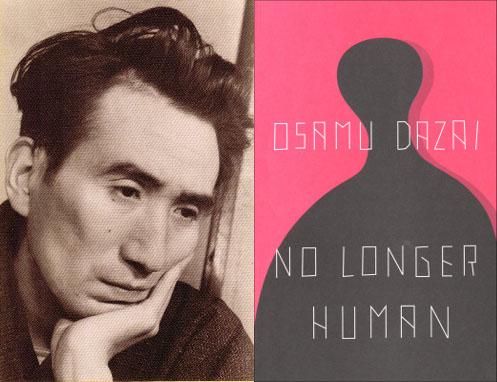
Osamu Dazai, No Longer Human

Osamu Dazai – No Longer Human | There and back again

I came across this book on my goodreads homepage in the form of a review. I read the review and was intrigued by the character’s feelings of isolation and stoicism and hence, decided to read the book immediately. I’ve been trying to read authors from around the world lately and No Longer Human by Osamu Dazai is my latest addition to reading Japanese authors after having read Haruki Murakami and Hiromi Kawakami. I like to read up on the author before venturing into a book since it helps me understand things better and from what I read, his style of writing seems to be semi-autobiographical. I shall, however, refrain from drawing parallels from the authors life since you can do it yourself.

The book is divided into three parts, referred to as ‘books’ and the third book has two parts. The book starts with the protagonist Oba Yozo’s childhood and chronicles his odyssey as a troubled and taciturn person. Since the inception, he experiences a sense of isolation, an inability to express his true feelings to the world and also a peculiar dislike for human beings. In the first memorandum, he starts to feel a deep sense of alienation, finds it difficult to converse with other people and experiences a mortal dread of human beings. He feigns emotions in everything he does or says . I start developing a distaste for the character after his self-destructive streak of bottling up and feigning emotions exacerbates in the second memorandum due to excessive drinking, smoking and encounters with prostitutes. It also sort of deals with human relationships in the context of an adverse socio-economic status. To me, the third memorandum felt like an extended and more intense streak of destructive behavior not only towards himself but also towards others. He finally feels disqualified to be a human being.

I had mixed feelings from reading about a character such as Yozo. I was able to relate to some of his fears and sense of alienation but at the same time was unable to comprehend his lack of empathy for those around him. The way I comprehended the book, it felt like his lack of empathy arose as a defense mechanism to avoid pain due to his troubled relationship with his father and this dangerous habit of feigning emotions and reclusiveness followed him throughout his journey in the book. I personally feel like this is a book about depression and addiction, and it is way way way more real, beautifully written, raw and better than what kids read nowadays like ‘Thirteen Reasons Why’.

It was quite a struggle for me to continue reading this book because it felt asphyxiating at times. I also felt like some of the book was lost in translation and the translator could have done a better job with the translation, perhaps?

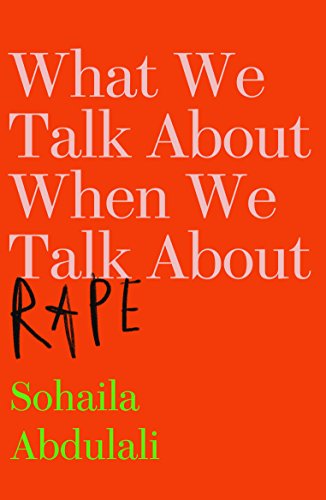
Sohaila Abdulali, What We Talk About When We Talk About Rape

What We Talk About When We Talk About Rape eBook: Abdulali ...

After reading what is now in my ‘100 books to read in a lifetime’ list, I realized how inadequate and superficial the conversation about rape and sexual assault is. Anyway, cutting to the chase, I loved this book.

Sohaila Abdulali is a writer, counselor, activist and survivor who delves into multifarious questions surrounding sexual assault and rape globally. For this book, she draws on her own experience, experiences of others, heavy research and her work as a head of a rape crisis center in Boston.

The book was brilliant for me because it’s a step forward in decrying the awkward silence that comes with conversations around rape and assault. It felt like a conversation full of insights, personal experiences and experiences of others. There are people from all over the world narrating their experiences with rape and abuse cutting across class, across profession and across regions.

The book made me pause and re-evaluate my preconceived notions about rape, objectification, humanity, and consent. The book opened my eyes, for instance, I did not know people could experience something like dentophobia after a horrifying experience. Or the story of Thordis & Tom. For those who don’t know, Thordis Elva was raped by her boyfriend Tom Stranger, an exchange student from Australia and after several years of torment she wrote to Tom to tell him of the pain he had inflicted on her. This marked the start of an eight-year correspondence culminating in the two of them meeting in Cape Town in 2013 and they later went on to start “The forgiveness project“that shares stories from both victims/survivors and perpetrators of crime and conflict who have rebuilt their lives following hurt and trauma. I found this story particularly fascinating.

I also had my light-bulb moment after learning that rape does not just happen because of objectification of women, there are multiple factors at play. The fact that one seeks vengeance, or seeks power over someone or seeks to humiliate is not because they view their victims as objects. We don’t feel the urge to humiliate objects. She also talks about mercy, about the taboos, incest, the prevention (if there really is one), difference between sex workers and trafficked humans, sexual autonomy, patriarchy and most importantly about rape.

Design a site like this with WordPress.com
Get started