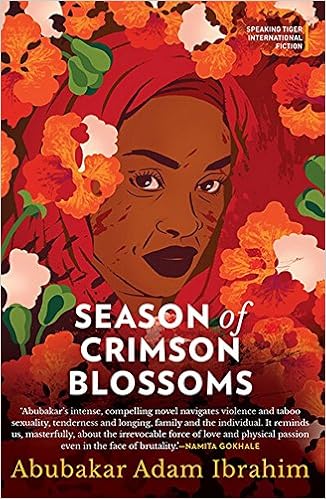
Season of Crimson Blossoms,
by Abubakar Adam Ibrahim,
Published by Speaking Tiger (2017)
Genre: Literary Fiction, Contemporary fiction
Rating: 5/5
The writing in Season of Crimson Blossoms is unlike anything I’ve ever read. I was interested in the title since the book is centered around Nigerian Muslims- a place and religion that I know next to nothing about. I would definitely call this literary fiction since the book focused more on characters rather than the plot (which I loved).
Plot and Other Thoughts
The book indubitably has one of the best opening lines I’ve ever read- “Hajiya Binta Zubairu was finally born at fifty-five when a dark-lipped rogue with short, spiky hair, like a field of miniscule anthills, scaled her fence and landed, boots and all, in the puddle that was her heart“. Hajiya Binta is 55, a widow and falls for a 25 year old Reza, a hoodlum who breaks into her house one afternoon but aborts this mission of his as soon as he notices a golden tooth in her mouth because it reminds him of his mother. In each other, both the characters find someone from their past that they loved and lost – Hajiya sees a glimpse of her deceased son in Reza and Reza sees a glimpse of his mother in Hajiya. Hence, their illicit love affair and longings unfurls against a backdrop of political corruption, violence, religious fundamentalism and patriarchal society in Nigeria. Their clandestine story is one that walks a forbidden path and defies age, class and religion. Through Reza, Hajiya is able to enjoy herself and no longer has to repress her desires of love and lust- which she did in her marriage with Zubairu (someone she was forced to marry at a very young age).
In an ideal world, Hajiya should be free to love and have sex with whomever she chooses to without having to think about others. Hajiya should not have to hide the most basic desires in life from her friends and family, but she does. These are the costs that we pay for loving and longing someone of our choice in a country and society that is marred with religion, patriarchy, violence and corruption. The book’s plot, religious settings and people’s mentalities were not very different from those found in my own country and hence it was relatively easier for me to ease into the story and understand the characters. Hindu or Muslim, India or Nigeria- we (not me, trust me) like our women (and also men) to be a certain way and to live up to harsh standards of a patriarchal society.
The novel is not only about the love affair between Hajiya and Reza but also builds up really well on the moods of other characters- their thoughts, experiences and desires in a violence and corruption ridden country. Throughout the course of the novel we read about the intense desires, troubles and emotions; such as trauma, jealousy and loneliness of each of these characters.
Conclusion
I love a book that is this layered and that peels off beautifully. The characters and some of the incidents linger long after you’ve read the book and I think that is wonderful. Definitely one of the best finds I’ve made this year. I also loved the literary references made in the book, I made a list of all the books that were mentioned in the novel. The only problematic thing about the book was the umpteen number of phrases and words in Hausa, I would have preferred some translation in parentheses. I’m definitely looking forward to more of his writing. After reading the book I realized that there is a glossary of the Hausa phrases available on the internet, please click here to find it.

 Literature, Poetry and Reading.