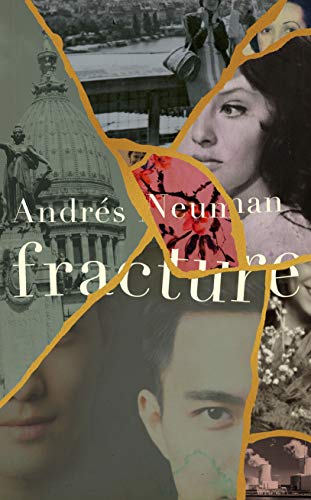
Fracture by Andres Neuman- A threnody to victims of war around the world and a hopeful novel about the power of love

Fracture eBook: Neuman, Andrés, Caistor, Nick, Garcia, Lorenza: Amazon.in:  Kindle Store
Publisher- Granta Books
Genre- Historical Fiction, Literary Fiction
Rating- 4/5

An earthquake fractures the present, shatters perspective, shifts memory plates.

Rarely does one come across prose as raw and resplendent as this one. The emotions of the characters was portrayed beautifully in Neuman’s Fracture. It is rare for me to cry while reading a book but I cannot help it when an author writes with such unusual vividness to detail and memory.

Mr. Watanabe is a hibakusha– someone affected by the 1945 atomic bombings of Hiroshima and Nagasaki. The book starts with Mr. Watanabe feeling the tremors of the 2011 earthquake that preceded the Fukushima nuclear disaster. The earthquake brings old wounds and experiences to the present. The novel is intermittently narrated through the eyes of four women- Violet from Paris, Lorrie from New York, Mariela from Argentina and Carmen from Madrid who speak about their acquaintance with Mr.Watanabe as well as politics in their respective countries, love and intimacy among others. They tell their own stories of loving Mr. Watanabe to a journalist who is obsessed with uncovering the past. Each character in the story has multiple perspectives and stories to tell and at the intersection of them all is the will to love in the face of catastrophes.

At the heart of the novel is the fatuousness of weapons and wars and the many lives that they affect, countless victims that they produce and the immeasurable amount of suffering that runs rife for a lifetime. Societies across the world are built around wars and its lingering memories, so imagine the multitude of emotions they still continue to evoke- from loss and longing to love and belonging.

One of the things that stood out for me is Yoshi Watanabe’s description of his admiration for the ancient art of Kintsugi (when a piece of pottery breaks, the Kintsugi craftspeople place powderd gold into each crack to emphasize the spot where the break occured) and how human beings are more or less the same- beautiful things emerge from broken things. [quoting Neuman, “Exposed rather than concealed, these fractures and their repair occupy a central place in the history of the object. By accentuating this memory, it is ennobled. Something that has survived damage can be considered more valuable, more beautiful.”] Fracture is about so many things but it is mostly about the fault lines and scars- whether physical or emotional or both- that each of us carry within ourselves for a lifetime and that remembering and acknowledging them is a braver exercise than forgetting. Our pain and our past experiences, whether good or bad, make us who we are and we must adorn them. Why strive to forget when there is beauty in remembering, in knowing and in being who you are?

Last year, I spent a considerable amount of my time researching on weapons, disarmament, war and humanitarian law so I was very keen on reading a novel that touches on these themes and one that is a blend of fact and fiction. This book is not only a book about war and love but also about grief, language and culture. I was a little confused at the end of the novel but I loved the first 95% or so. Fracture is a remarkable multi-layered novel, one that I’m hoping many more people will read.

The book has been translated from the Spanish by Nick Caistor and Lorenza Garcia. Thank you to Granta Books for sending me a review copy!

The Lying Life of Adults by Elena Ferrante tr. by Ann Goldstein

The Lying Life of Adults - Elena Ferrante
Publisher: Europa Editions
Genre: Coming-of-age, literary fiction, bildungsroman
Rating: 4.5/5

“Two years before leaving home my father said to my mother that I was very ugly.” When a book opens with a line like that, you know it’s going to be an immersive read with some brilliant characterization and a sublime plot. The way Ferrante selects the most quotidian things and paints them with her vivid imagination and lyrical writing, bringing them to life in her reader’s mind is nothing short of exquisite.

With ‘The Lying Life of Adults’, Ferrante has made her way into my most favourite writers of all time list. I read Days of Abandonment by her earlier this year and thoroughly enjoyed it. The Lying Life of Adults is another coming-of-age literary masterpiece by Ferrante. The book pulls you into the story of Giovanna from the very beginning. The story follows the story of Giovanna spanning her 13-16th year as she grapples with her own self as well as the lives of adults around her. She belongs to an affluent family with academic parents, who live in an affluent neighbourhood and have like-minded friends. She transforms from being a compliant and sometimes, a trophy child to finding her own voice and asserting herself in front of her family, friends and other like-minded people from the so-called intelligentsia of Naples.

She is inexplicably drawn towards her father’s side of the family, especially her aunt Vittoria- the most hated person in her family- someone who is considered ugly inside out by Giovanna’s parents. After her father calls Giovanna ugly and compares her to his sister Vittoria, Giovanna sets off on a journey to the depths of Naples (a place of squalor and vulgarity) and also to the depths of her self, family secrets and other relationships. Her journey from the heights of Naples to the depths of Naples marks not only a physical journey from the North to the South but also her transition from childhood to adolescent.

What I loved about this book is the recurring theme of the superficial and hypocritical lives that adults live- they expect their children to be a certain way when they grow up- to be honest, just, etc., but they themselves lead a two-faced life of lies and double standards. The lives of adults are divided by class and wealth but united by their knack for lying. The book also touches on many other themes such as the constructs of beauty, the male gaze, faith, love and lust among others. The mention of umpteen number of Italian delicacies and places in the books transports you to her character’s Neapolitan world and culture. All the characters in Giovanna’s story are brilliant and unique in their own ways- you will love some and hate some but you will not forget them.

I loved how the story took shape, how the characters and their relationships with one another evolved throughout the novel and it gripped me from the very beginning, I was unable to put it down at any point. The ending was a tad bit disappointing- I wish it were different but I loved the book nonetheless. Perfect for fans of Murakami’s Norwegian Wood and Sputnik Sweetheart or anyone who fancies coming-of-age novels with visceral and interesting characters.

Thank you to the publishers, Europa Editions UK for sending me a copy, I was beyond elated to have found this in my mail and I devoured it immediately.

Elastic by Johanne Bille tr. by Sherilyn Hellberg

Publishers: Lolli Editions
Genre: Queer literure, literary fiction, bildungsroman, coming-of-age
Rating: 5/5

Elastic- stretchable, malleable but also prone to slacking over time. That’s how I would describe Alice’s story- something that she herself doesn’t understand before it is too late. The book starts with the protagonist, Alice examining her vagina and feeling alienated from her own body and disconsolate about her sexuality.

She is content with her partner Simon, they love each other and live together and things are fine. Enter Mathilde, and Alice’s life changes. Mathilde is Alice’s colleague and Alice is drawn to Mathilde like a moth drawn to a flame. Enter Alexander – Mathilde’s husband – and things take an even more complicated turn. Alexander and Mathilde are in an open marriage and to get closer to Mathilde, Alice starts to sleep with Alexander. Alexander is merely the means to get to the end, to Mathilde.

Eventually, Alice also discovers secrets from Simon, and after that, it’s a roller coaster ride that takes us through this quadrilateral relationship- of love, of intimacy, of desire, of jealousy, of hate, of queerness, of identity and of feminine struggles.

Johanne Bille did a marvelous job with this book- amalgamating the many sides to human identity and relationships into one story narrated by Alice’s complex character. Despite the many themes and the many moods of Alice that the book touches upon, the writing is perspicuous through and through.

I thought, I thought and I thought and could not think of any adjectives to describe the book. The imagery is wonderful, the translation is lyrical, the writing is brilliant, the story is emotional and I just choked up in the end. Please read it, NOW.

Flexing Muscles by Ravikumar Kashi

Publisher- Reliable Copy
Genre- Non-Fiction, Essay
Rating- 5/5

Flexing Muscles is an amalgamation of a long form essay in English and Kannada by Ravikumar Kashi. The book is a meditation on the political flex banners that have helped shape the narrative of Bangalore in recent times. The book is replete with photographs collected by the author- of political flex banners and some ancient paintings which help us understand the format of present day flex banners. The author reflects on the history of flex banners and their significance in urban Bangalore’s visual popular culture and changing political narrative.

The essay is divided into five parts. In the first part titled ‘Navigating the City’, the author describes the changing demographic of Bangalore. He also writes about how Bangalore became the silicon valley of India and a cosmopolitan city.

In ‘Optics and Narratives’, the author reflects on the history of how flex banners became popular for reaching out to large audiences and their emergence in the city- flex banners were and continue to be a suitable medium for visual communication due to their cheap production costs and durability .

In ‘Posture and Position’, the author reflects on the format of flex banners- how the photos of the people on these political banners reflect the hierarchies and relationship between the persons- he also compares them to some paintings from the past. For instance- in a flex banner, the most prominent person’s image will be the largest and those of his followers will be smaller in size; similarly in a painting of Lord Vishnu, he occupies the center position and his character is greater in size than goddess Lakshmi who occupies a much smaller space in the painting – thus, there is a common thread that connects historical paintings and today’s flex banners.

In ‘Age of the Sene’ the author writes about an aggressive and chauvinistic side of Bangalore- the one that uses these flex banners to evoke authority, support and power from the local people. Multifarious sene groups have emerged on the scene in the last decade who seek to protect their culture, land and language from “outsiders”. They’ve taken up their roles as protectors exposing their hyper masculine intentions of protecting their supposedly feminine and fragile land and language.

In the last part titled ‘Echo Chamber’, the author writes about how the messages and sentiments expressed through flex banners is a significant one due to their scale and physical presence. Simply removing these banners does not change the latent anxieties that need to be resolved; by removing them, we make these anxieties invisible instead.

Political flex banners tell us a lot about an area- changing through time and space, marking new territories and shaping new narratives. Flexing Muscles is a book that explores the significance of these banners in present day visual culture and political narrative of Bangalore. It was a fast-paced essay and one that was well-researched and informative with interesting citations, illustrations and personal anecdotes. The Kannada version of the essay is also available in the same book. I enjoyed reading it thoroughly and would recommend it to anyone interested in learning and reading about Bangalore or flex banners.

A Silent Fury by Yuri Herrera tr. by Lisa Dillman

A Silent Fury: The El Bordo Mine Fire by Yuri Herrera
Publisher- And Other Stories
Genre- Non-Fiction, History
Rating- 3.5/5

A Silent Fury was a quick, medium-paced book which I finished in two sittings yesterday. It was a fascinating, informative and hair-curling read about the El Bordo mine fire which took place on the 10th of March in Pachuca, Mexico. I enjoyed reading the book but at times it did feel more like academic writing than a book.

The fire broke out and the alarm was raised at six in the morning. The shafts were sealed hastily after that and the company administrators declared that no more than ten lives remained inside the shafts. The administrators also very confidently assumed and proclaimed that those who were left inside were already dead since it would not take more than five minutes for the noxious gases to kill a person.

Once the mine was reopened after the fire, there were eighty-seven dead bodies- charred and disfigured, and also seven survivors. This is the turning point which highlights the ignorant and irresponsible actions of the company’s representatives. What seemed like an accident at first may have very well been a murder by the United States Smelting, Refining and Mining Company―the largest employer in the region.

Through this book, Yuri Herrera vividly exposes the bias and the war against workers by the judiciary, the company representatives and the media. He breaks the long silence on a wrong committed a century earlier. Herrera critically inspects the records left behind and forgotten a century after the incident took place. He also tries to analyze things that were never said or recorded, but should have been, for instance- how the women’s voices were stifled and the probe into the mine fire wherein the judge asked the inspector to look into a set of questions after the mine had already been cleaned post the fire. There was no probe into the Company representatives’ actions; or the discrepancies between what the representatives had to say about the fire and what the survivors had to say.

Herrera ends his book with a few more subsequent events that have highlighted workers’ abysmal conditions in Mexico and events that helped shape a movement. Herrera’s vexation about the misrepresentation of workers and their lives is evident on every page, as the title suggests- it is a silent fury.

Design a site like this with WordPress.com
Get started