New Passengers by Tine Høeg, tr. by Misha Hoekstra

Publisher- Lolli Editions
Genre- Bildungsroman, Fiction in verse, coming-of-age
Rating- 5/5

“I know I know I say

it’s a real mess

but it’s my body

it’s like it only exists
when it touches his

the rest of the time I’m this haze drifting about

New Passengers was my fourth WITmonth read and it is the first verse novel I’ve ever read and one that I loved. I finished this in one sitting today. The book is divided into months (August-December) and follows the unnamed narrator’s discovery of herself, her young feminine identity and what it means to be an adult. The novel starts with the narrator boarding the daily commute train from Copenhagen to Naestved where she’s landed a new job as a teacher in a school. On the train, she meets a married man to whom she is drawn irrevocably; and what follows are events through which the narrator confronts her own identity coupled with her relationship with this man. In between all of this exists her id- which does not let her extricate herself from this man and, her ego- which reminds her of the uneasiness and the immorality of infidelity.

The book flows with such lucidness and that too with sparse words- fiction that reads and looks like poetry. The translation was beautiful and captured all the nuances. Evocative, perspicuous and fact-paced like that of a train but also reflective, New Passengers is an amalgamation of love, reflections on adulthood and feminine identity in the contemporary world. I think the design of the book speaks so much for itself with the rectangle(s) on the chapter page that somewhat resembled commuter train carriages. With each progressing month, there is an extra rectangle/ carriage and by December (the last month), it was a complete commuter train. For me, this resembled closure and the start of a new adulthood.

I loved the coming-of-age story. I’m not sure but I think if I had to fit this into a genre, it would definitely be bildungsroman. This was definitely one of my favourite books in fiction this year and from what I can tell, will continue to be a favourite for days to come!

New Passengers was first published in Danish in 2017 titled ‘Nye rejsende’ and later translated into English by Misha Hoekstra which will be out on 10th September 2020! The book won the Englush PEN award and also ‘Bogforum’s Debutantpris’, the prize awarded each year for Denmark’s best literary debut.

Flights by Olga Tokarczuk, tr. by Jennifer Croft

Flights (novel) - Wikipedia
Published by- Fitzcarraldo Editions,
Genre- Literary fiction, memoir, auto-fiction
Rating- 4/5

I’ve wanted to read Flights ever since it was longlisted for the International Booker Prize in 2018 and since I saw a copy of the book at one of the stands at a bookstore inside Bangalore Airport. I was mostly drawn to the book due to its title and the plain cobalt blue cover, only later did I realize that Fitzcarraldo Editions has the same cover design for all their fiction novels.

Flights is a collection of vignettes- wayward and yet connected to anatomy, motion, psychology and travel somehow. I cannot say that I loved the book wholly and I cannot extrapolate the rules of synecdoche to this book since it was too different. I was indifferent to some parts of the book and the rest, I loved. It was difficult to understand her writing initially because, for the longest time, I kept trying to wrap my head around – what exactly is this book about? what is the purpose? But I think giving up on trying to find the “meaning or purpose” of this book helped me appreciate this a lot more. I just needed to let the book be, unfurl on its own and so when I ask you to read this with an open mind, please do. Don’t try to figure out what is happening or what is going to happen or the purpose. It’s a multifaceted book and an amalgamation of some visceral vignettes with brilliant prose. Some parts are so hauntingly vivid and some are just average or pointless but then again, the purpose of this book is that it honestly doesn’t have any, and I think that is pretty cool. It’s the kind of book that will either pull you into its lyrical and vivid prose or it will just confound you- for me, it did both. It was kind of like a flight taking off with exhilaration and then landing with some uneasy turbulence.

I’m in awe with the amount of research put into this book- I loved the bits about the Glasmensch by Franz Tschackert in the German Hygiene museum and the stories of the Dutch anatomist Filip Verheyen who dissected and drew pictures of his own amputated leg. I’m a fan of anatomy museums and I love watching carcasses of animals or human fetuses or other body parts float in glass jars, so this was 10/10 for me. I also love how Tokarczuk’s writing is embedded with compassion for the environment and animals (I loved ‘Ataturks Reforms’, ‘Whales or Drowning in Air’, and ‘On the Origin of Species’). A soft corner for the peculiar, the unfamiliar and the marginalized is at the heart of her writing [quoting Tokarczuk, “I’m not interested in the patters so scrutinized by statistics that everyone celebrated with a familiar, satisfied smile on their faces. My weakness is for teratology and for freaks. I believe, unswervingly, agonizingly, that it is in freaks that Being breaks through to the surface and reveals its true nature”]. One of my favourite vignettes is ‘Your Head in the World’ where she talks about her psychology degree, which also took me back to those two years when I superficially studied Psychology in junior college [quoting Tokarczuk, “What we learned at university was that we are made up of defences, of shields and armour, that we are cities whose architecture essentially comes down to walls, ramparts, strongholds: bunker states”].

Somewhere in the middle of the book, I read up on Olga Tokarczuk’s life and novels and also this particular novel and it kind of helped me appreciate the book a little more. As for the translation, I do not know Polish but I can say with some conviction that Croft’s translation does not disappoint. This book definitely calls for a re-read for a better understanding I guess!

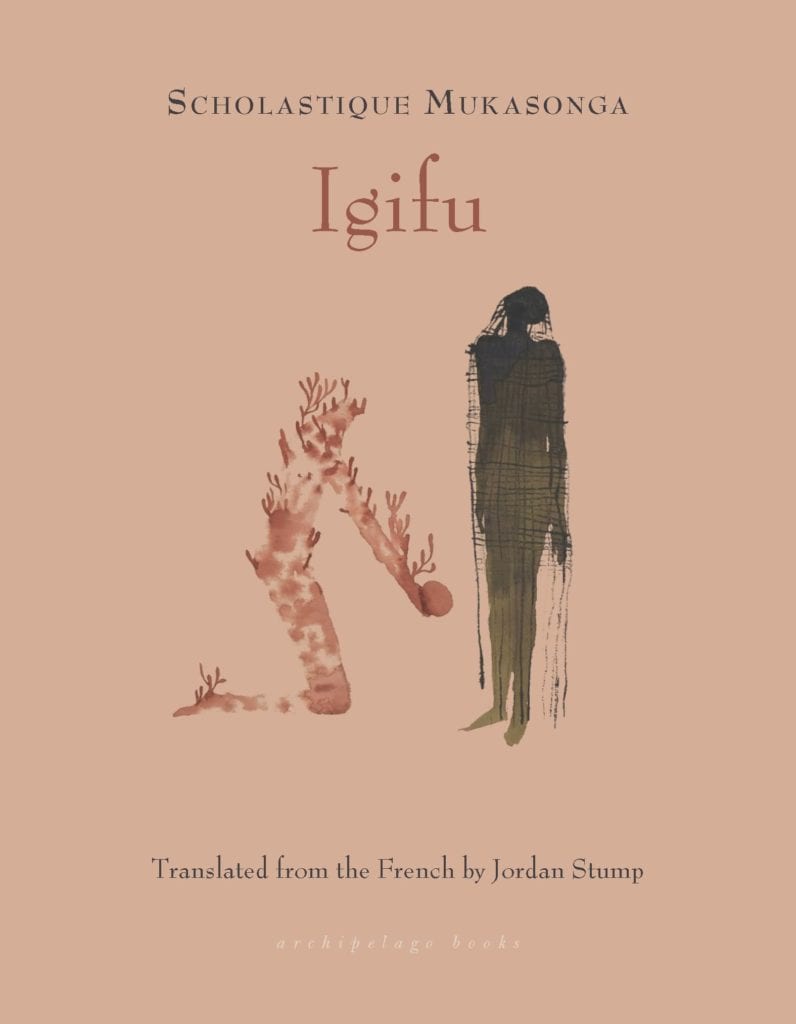
Igifu by Scholastique Mukasonga, tr. by Jordan Stump

Igifu – Archipelago Books

Igifu,
Scholastique Mukasonga tr. by Jordan Stump
Published by Archipelago Books
Genre- Autobiographical fiction, Short Stories
Rating: 5/5

“In Nyamata,’ my mother used to say, ‘you must never forget: we’re Inyenzi, we’re cockroaches, snakes, vermin. Whenever you meet a soldier or a militiaman or a stranger, remember: he’s planning to kill you, and he knows he will, one day or another, him or someone else”.

Igifu, or hunger, is a collection of autobiographical stories by the French-Rwandan author Scholastique Mukasonga and is translated from the French to English by Jordan Stump. In the centre of these stories is the collective grief and predicament of Tutsis -the living, the dead and the exiled – before and after the Rawandan genocide. Each story is heartwrenchingly beautiful, visceral and permeates through all yours senses.

The first story in the book is called ‘Igifu’, where the author takes us through a literary experience of hunger- of what it means to have this implacable tormentor within and what it does to the human body and mind. They knew how to satiate Igifu when they had their cows but the cows were taken away and killed, and the Tutsis were abandoned on the sterile soil of the Bugesera, Igifu’s kingdom. (“Igifu woke you long before the chattering birds announced the first light of dawn, he stretched out the blazing afternoon hours, he stayed at your side on the mat to bedevil your sleep. He was the heartless magician who conjured up lying mirages: the sight of a heap of steaming beans or a beautiful white ball of manioc paste, the glorious smell of the sauce on a huge dish of bananas, the sound of roast corn crackling over a charcoal fire, and then just when you were about to reach out for that mouthwatering food it would all dissolve like the mist on the swamp, and then you heard Igifu cackling deep in your stomach.”)

The second story is called “The Glorious Cow” where the author reminisces the halcyon days of when they had a lot of cows. The cows were given names, looked after and were the most important members in the family. Here, we learn the cultural and agricultural importance of the cow in Tutsi families. Milk after all, helped keep Igifu away. The third story, which almost had me in tears is called “Fear”- the fear of the sound of boots, of soldiers planning to kill, where you have to be quicker than death. Fear is their guardian angel, it helps them stay alert and awake for when death knocks, you have to run faster than death. The fourth story is called “The Curse of Beauty”- of how beauty was the greatest sorrow in the life of a Tutsi woman that extricated her from her husband, her son and herself. The last story in the book is “Grief”- here, the author writes about what it is like to lose people to a genocide and what it takes to come to terms with it (“That strength lives in you too, don’t let anyone try to tell you to get over your loss, not if that means saying goodbye to your dead. You can’t: they’ll never leave you, they stay by your side to give you the courage to live, to triumph over obstacles, whether here in Rwanda or abroad, if you go back. They’re always beside you, and you can always depend on them.”)

Igifu was my first read for Women in Translation month. WITMonth started in response to literary blogger Meytal Radzinski’s observation that only around 30% of books published in translation were by women. The purpose is to support women writers in translations and to bridge the gap through reading, reviewing and discussing books by women writers in translations.

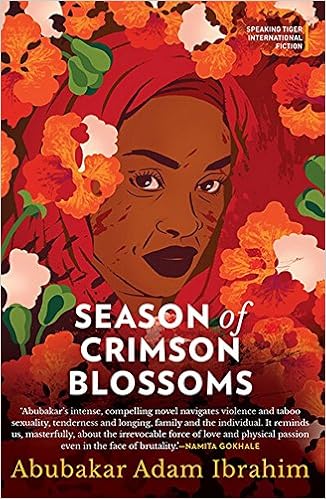
Season of Crimson Blossoms by Abubakar Adam Ibrahim

Buy Season of Crimson Blossoms Book Online at Low Prices in India ...

Season of Crimson Blossoms,

by Abubakar Adam Ibrahim,

Published by Speaking Tiger (2017)

Genre: Literary Fiction, Contemporary fiction

Rating: 5/5

The writing in Season of Crimson Blossoms is unlike anything I’ve ever read. I was interested in the title since the book is centered around Nigerian Muslims- a place and religion that I know next to nothing about. I would definitely call this literary fiction since the book focused more on characters rather than the plot (which I loved).

Plot and Other Thoughts

The book indubitably has one of the best opening lines I’ve ever read- “Hajiya Binta Zubairu was finally born at fifty-five when a dark-lipped rogue with short, spiky hair, like a field of miniscule anthills, scaled her fence and landed, boots and all, in the puddle that was her heart“. Hajiya Binta is 55, a widow and falls for a 25 year old Reza, a hoodlum who breaks into her house one afternoon but aborts this mission of his as soon as he notices a golden tooth in her mouth because it reminds him of his mother. In each other, both the characters find someone from their past that they loved and lost – Hajiya sees a glimpse of her deceased son in Reza and Reza sees a glimpse of his mother in Hajiya. Hence, their illicit love affair and longings unfurls against a backdrop of political corruption, violence, religious fundamentalism and patriarchal society in Nigeria. Their clandestine story is one that walks a forbidden path and defies age, class and religion. Through Reza, Hajiya is able to enjoy herself and no longer has to repress her desires of love and lust- which she did in her marriage with Zubairu (someone she was forced to marry at a very young age).

In an ideal world, Hajiya should be free to love and have sex with whomever she chooses to without having to think about others. Hajiya should not have to hide the most basic desires in life from her friends and family, but she does. These are the costs that we pay for loving and longing someone of our choice in a country and society that is marred with religion, patriarchy, violence and corruption. The book’s plot, religious settings and people’s mentalities were not very different from those found in my own country and hence it was relatively easier for me to ease into the story and understand the characters. Hindu or Muslim, India or Nigeria- we (not me, trust me) like our women (and also men) to be a certain way and to live up to harsh standards of a patriarchal society.

The novel is not only about the love affair between Hajiya and Reza but also builds up really well on the moods of other characters- their thoughts, experiences and desires in a violence and corruption ridden country. Throughout the course of the novel we read about the intense desires, troubles and emotions; such as trauma, jealousy and loneliness of each of these characters.

Conclusion

I love a book that is this layered and that peels off beautifully. The characters and some of the incidents linger long after you’ve read the book and I think that is wonderful. Definitely one of the best finds I’ve made this year. I also loved the literary references made in the book, I made a list of all the books that were mentioned in the novel. The only problematic thing about the book was the umpteen number of phrases and words in Hausa, I would have preferred some translation in parentheses. I’m definitely looking forward to more of his writing. After reading the book I realized that there is a glossary of the Hausa phrases available on the internet, please click here to find it.

Design a site like this with WordPress.com
Get started